Metal ion contamination during dry etch impacting your yield?
The source of metal ion contamination within your dry etch process is simply the metallic assemblies that deliver the reactive process gases to the process chamber. Equipment manufacturers go to great lengths to ensure systems are manufactured to the highest purity levels; assembled in cleanrooms and validated to SEMI standards such as 49.6 and 49.8, where key parameters such as oxygen, THC and especially moisture are qualified down to ppb levels. the process is off to a great start.
The very nature of dry etch processing uses reactive gases. HBr, fluorine based gases such as CF₄, SF₆, CHF₃ or chlorine based gases such as HCl, Cl₂, BCl₃. SF₆ is another common gas utilised.
Whilst all of the process gases are ultra high purity and anhydrous, as they’re controlled and delivered through the point of use gas control system, controlled to precise levels of mass flow rates, these reactive gases are interacting with the bear metal surfaces, typically 316L stainless steel.

High purity applications demand electropolished tubing and components. Electropolishing changes the surface chemistry, increasing the chromium and nickel content at the surface. It also removes free iron and the higher chromium content improves corrosion resistance, when compared to untreated stainless steel. The end result is a clean, mirror like surface. Fundamentally though, you’re still exposing the reactive gases to a metallic surface.
You’ve taken steps to ensure the purity of your process gases, the system is qualified as clean and dry, to ppb levels, and your instrumentation is equally to high purity standards and electropolished. And yet with all your best efforts and operating procedures, metal ion contamination is still compromising yield and having a detrimental affect.
What’s the solution? Remove the source of contamination. Create a truly inert, non metallic wetted surface.
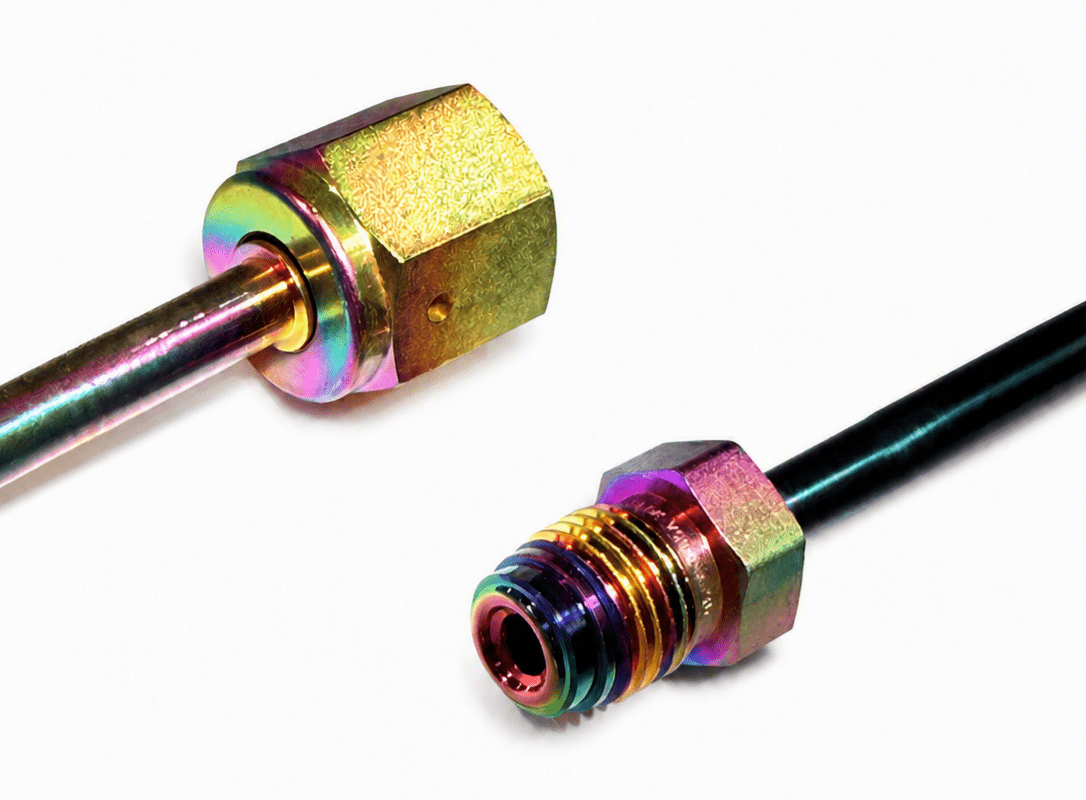
The title image shows VCR type fittings and tubing coated with SilcoTek’s innovative amorphous silicon coating. Applied via a proprietary CVD process, the end result is a highly inert, ultraclean coating only a few hundred nanometres thick. The entire internal surface is 100% coated. The coating process can be applied to very complex geometries, valves, filters and other instrumentation components, where the wetted surface is exposed to reactive media.
Depositing onto metal surfaces at high temperatures can create concerns of metal diffusion into the coating layer. As can be seen in the Auger Electron Spectroscopy (AES) below, metals are not detected within the bulk of the coating layer.

The depth profile illustrates there are no metal elements present in the first 2000 angstroms, and they only start to become present in the diffusion zone. The coating is molecularly bound to the stainless steel.
We also need to consider electropolishing. As stated above, electropolishing does alter the surface chemistry and improve the corrosion resistance of the base metal. Does it improve enough though, to prevent reactions with the media?
The image below presents four test pieces. Each one was exposed to a 5% HCl concentration.

It’s clear that there has been a reaction on the two test pieces that are not coated, including the electropolished piece. Electropolishing does improve corrosion resistance and anecdotally you can see that in the test pieces above. What is evident though is that a reaction has occurred on the electropolished test piece. Conversely the two coated samples demonstrate no reaction to the exposure at all.
The coating is conformal. Whatever the surface finish is prior to coating, the same surface finish will be present after coating. The coatings can be applied to electropolished surfaces without issue, and you will retain the same surface finish. The only difference being the wetted surface is now completely inert and free from potential metal ion contamination sources.
SilcoTek frequently coat the transfer lines, downstream of the mass flow controllers, delivering the gas mix to the process chamber. This is subjected to the most reactive conditions and where you can expect the highest level of reaction with untreated stainless tubing.
If you’re ticking all the boxes for system cleanliness and process control, yet still finding metal ion contamination is the Achilles heel in your dry etch process and yield is suffering, its time to address the source of contamination, the metal surfaces delivering the process gas mix.
Reach out to OptiFab to learn more about this innovative coating, and explore if we can solve your metal ion contamination process issues.
‹ Back to Articles