Coatings that improve UHP levels in semiconductor manufacturing
Semiconductor manufacturing is one of the most demanding industries when it comes to material purity. From the chemicals used during fabrication to the equipment responsible for delivering them, every material that comes into contact with a process has the potential to influence its performance. Even small amounts of unwanted contamination can create significant challenges. Metal ions, particles, moisture, and reactive surfaces can interfere with manufacturing processes, contribute to equipment failures, and negatively affect production yield.
Maintaining ultra high purity requires more than simply selecting high quality process chemicals. Manufacturers and equipment OEMs must also consider the materials used throughout their equipment, including the surfaces of tubing, valves, fittings, reactors, and other critical components. Understanding how these materials interact with their environment is an important part of protecting semiconductor manufacturing processes.
What does ultra high purity mean in semiconductor manufacturing?
A process gas may meet its required purity specifications when it enters a delivery system. However, if the gas encounters a reactive or corroding surface during transport, its composition may be affected before it reaches the intended process. The same principle applies to liquid chemicals and other process materials. Even substances commonly considered relatively benign can interact with metal surfaces under certain conditions. SilcoTek has demonstrated that materials such as stainless steel and Hastelloy can release measurable metal ions when exposed to high purity solvents and deionized water. These findings illustrate an important distinction: The purity of a process fluid depends not only on its initial composition, but also on the surfaces it encounters during use.
Understanding the sources of contamination
Contamination can originate from several sources throughout semiconductor manufacturing equipment. Some contaminants enter with process materials, while others develop through interactions between chemicals and equipment surfaces.
Three important considerations are metal contamination, particulate generation, and moisture.
Metal ion contamination
Metal ion contamination can occur when process chemicals interact with metallic equipment surfaces. Stainless steel is commonly used in semiconductor manufacturing equipment because of its strength, durability, and manufacturability. However, stainless steel is not chemically inert under every operating condition. Exposure to certain chemicals can cause metals such as iron, nickel, and chromium to leach from wetted surfaces. These contaminants can enter process streams and potentially negatively affect yield.
SilcoTek has investigated metal ion leaching from several commonly used materials, including stainless steel, Hastelloy, titanium, and MP35N. The results demonstrate that the relationship between a material and its surrounding chemistry is an important consideration when selecting components for high purity applications.
Particulate contamination
Particles are another concern in semiconductor manufacturing. Corrosion of metallic components can produce particles that enter process streams or accumulate within equipment.
In semiconductor applications, corrosion related particles can contribute to contamination, equipment maintenance requirements, and potential yield losses. This makes the condition of equipment surfaces particularly important in environments where aggressive process chemistries are present. Material selection, chemical compatibility, and corrosion resistance all play roles in controlling this potential contamination source.
Moisture and surface interactions
Moisture is another consideration in semiconductor process environments, particularly when working with moisture sensitive or reactive chemistries. Surfaces can interact with moisture in different ways depending on their chemical composition and surface properties. HBr is a classic example. When the cylinder pigtail starts to indicate a reaction, what condition are the wetted surfaces upstream?
For applications involving metal halides and other sensitive chemistries, controlling moisture interactions can be an important part of maintaining process conditions. SilcoTek’s Dursan® coating, for example, provides a hydrophobic silicon oxide surface that can help control moisture related surface interactions in appropriate semiconductor applications. These properties demonstrate how modifying the surface of a component can provide additional functionality beyond that of the underlying material.
Why high purity chemicals can still cause contamination
One of the more surprising challenges in maintaining process purity is that contamination does not always require exposure to an extremely aggressive chemical. Even high purity solvents and deionized water can interact with certain metallic surfaces.
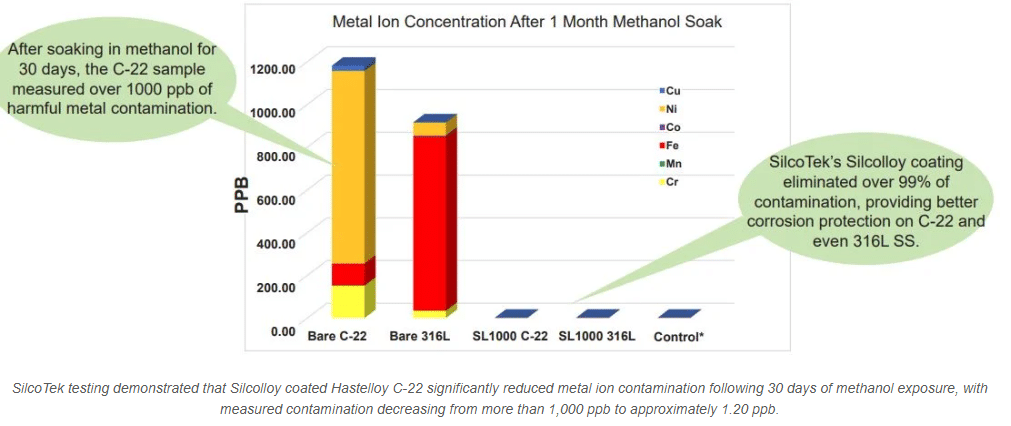
SilcoTek investigated this behavior by exposing coated and uncoated metal samples to methanol and measuring the resulting metal contamination. In one study, samples were immersed in methanol for 30 days before the solutions were analysed for metal ions. The results showed that uncoated Hastelloy C-22 released more than 1,000 parts per billion (ppb) of metal contamination. By comparison, the Silcolloy® coated Hastelloy C-22 sample produced approximately 1.20 ppb of measured metal contamination. This represents a reduction of more than 99% in measured metal contamination under the tested conditions! The results demonstrate how the surface of a material can influence the purity of a fluid, even when the fluid itself begins as a high purity substance. For semiconductor manufacturers, these findings reinforce the importance of evaluating the compatibility of equipment surfaces with the chemicals they encounter.
The importance of material purity throughout semiconductor equipment
Maintaining high purity requires attention to more than the process chamber itself. Semiconductor manufacturing systems contain numerous components responsible for storing, transporting, controlling, and removing process chemicals. These components can include gas delivery tubing, valves, fittings, regulators, filters, manifolds, reactors, and exhaust equipment. Each component introduces additional surfaces that may interact with the chemicals moving through the system.
Materials entering the process chamber
Before process chemicals reach the chamber, they travel through an extensive network of delivery equipment. Depending on the application, these chemicals can be reactive or corrosive toward conventional metallic surfaces. If corrosion occurs, the resulting metal ions or particles may be carried downstream. This creates an opportunity for contamination before the chemicals reach the intended manufacturing process. For this reason, semiconductor equipment manufacturers must consider both the chemical compatibility and surface properties of components throughout the delivery system.
Materials leaving the process chamber
The challenges do not end once the manufacturing process is complete. Exhaust systems can encounter aggressive chemical species that create different material compatibility concerns.
For example, SilcoTek has documented semiconductor applications involving fluorine-containing exhaust streams and the corrosion challenges they create for metallic components. Protecting these downstream surfaces can help reduce corrosion related maintenance and improve equipment reliability. Although the environments entering and leaving a process chamber may differ, both require careful consideration of the materials exposed to process chemicals.
How SilcoTek’s CVD process supports ultra high purity
Selecting an appropriate bulk material is an important first step in designing semiconductor equipment. However, the properties needed for mechanical performance are not always the same as those required for chemical compatibility. Stainless steel, for example, offers several advantages for manufacturing complex components. Yet its surface may still be susceptible to chemical reactions under certain operating conditions. Surface engineering provides a way to modify the properties of a material without replacing the entire component.
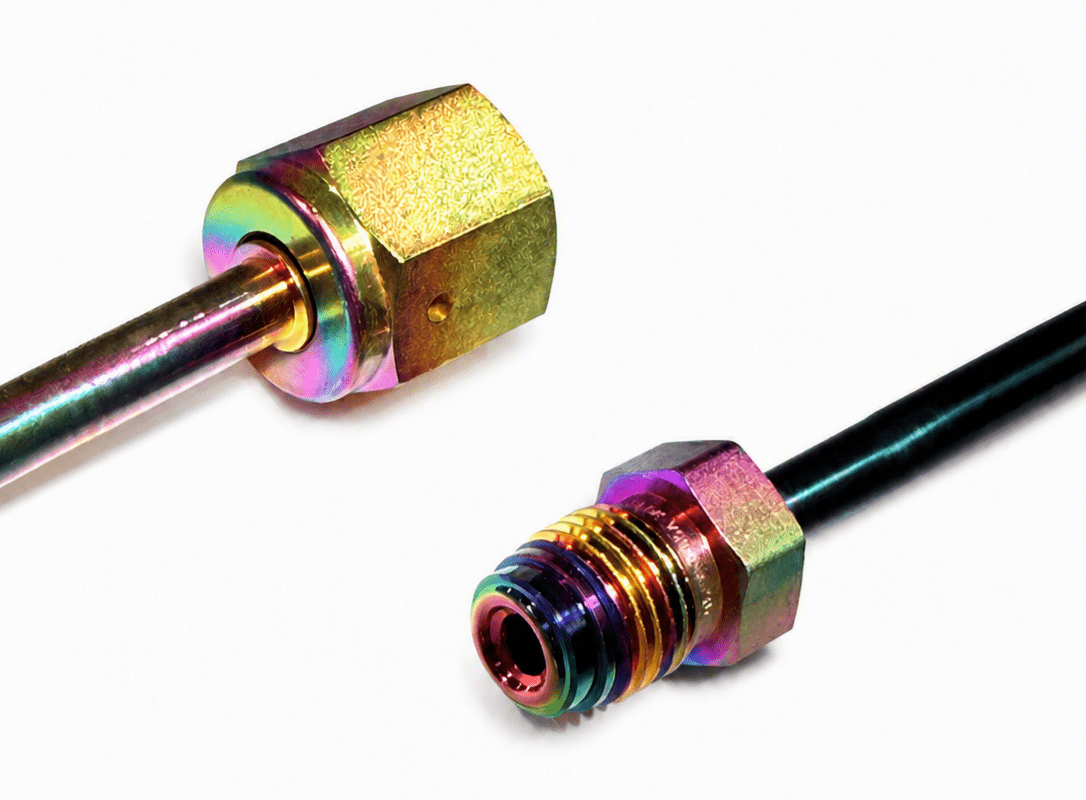
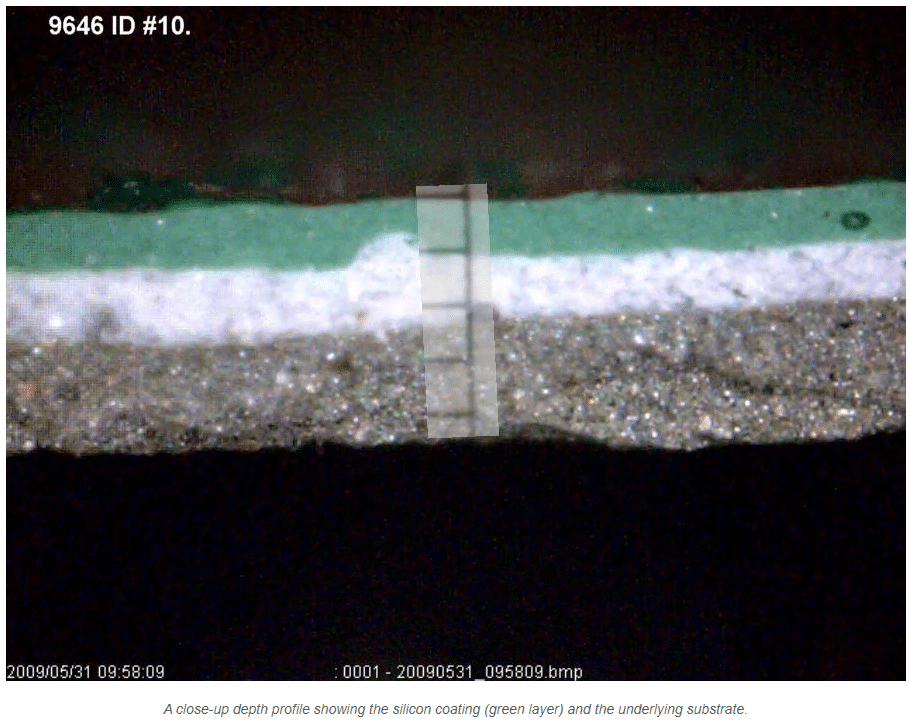
SilcoTek uses chemical vapour deposition (CVD) to apply thin, conformal silicon based coatings to stainless steel and other compatible substrates. These coatings create a barrier between the underlying material and its surrounding environment.
Depending on the coating selected, surface engineering can help improve:
- Resistance to chemical corrosion
- Protection against metal ion leaching
- Chemical inertness
- Moisture related surface properties
- Equipment durability and reliability
Because SilcoTek’s CVD process is not limited to line of sight deposition, coatings can reach intricate internal surfaces, including those found in tubing, valves, fittings, and other complex components. This allows manufacturers to retain the mechanical advantages of the underlying substrate while modifying the properties of surfaces exposed to process chemicals.
How pure are SilcoTek’s silicon coatings?
The composition of a protective coating is particularly important when it is being used in an application where contamination must be minimised. SilcoTek has evaluated the purity of its silicon CVD coatings with a reported silicon coating purity of 99.98%.
Testing for common metallic contaminants produced the following results:
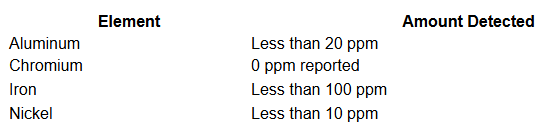
These measurements characterise metallic impurities within the coating material itself, rather than the concentration of contaminants released into a process stream. By creating a high purity silicon barrier over a metallic substrate, SilcoTek coatings can reduce direct contact between process chemicals and the underlying metal. This approach provides an additional option for manufacturers seeking to improve material compatibility and reduce potential contamination sources.
Choosing the right coating for semiconductor applications
Not every semiconductor process presents the same material challenges. Different chemicals, temperatures, and operating environments require different surface properties.
SilcoTek offers several CVD coatings designed to address specific semiconductor equipment requirements.
Silcolloy 2000 is a high purity amorphous silicon coating used as a protective barrier in corrosive environments (dry etch), including applications upstream from semiconductor processing chambers. Its silicon surface helps protect the underlying metal from chemical interactions.
Dursan is a hydrophobic silicon oxide coating that provides corrosion resistance and moisture related surface properties. It can be useful in appropriate non-plasma applications involving precursor storage, chemical delivery, and exhaust systems.
Siltride 1000 is a thermally stable silicon oxynitride coating designed for demanding environments, including certain applications involving non-plasma fluorine exposure. It has been used in semiconductor sub-fab equipment to address corrosion and maintenance challenges.
The appropriate coating depends on the specific chemicals, operating conditions, and performance requirements of the application. Evaluating these conditions before selecting a coating is essential to achieving the best results.
Protecting purity means looking beyond the starting material
UHP semiconductor manufacturing requires a comprehensive approach to contamination control. While the purity of incoming chemicals and gases is important, manufacturers and equipment OEMs must also consider how those materials interact with equipment throughout the process. Metal ion leaching, corrosion related particles, and surface interactions can introduce additional challenges, even when the original process materials meet their purity requirements. By evaluating the materials used throughout semiconductor manufacturing systems, engineers can identify opportunities to reduce contamination and improve equipment reliability.
SilcoTek’s CVD coatings provide one approach to addressing these challenges by creating high purity, chemically resistant surfaces on existing metallic components. From chemical delivery to process exhaust, selecting compatible materials and surface treatments can help manufacturers and equipment OEMs protect critical equipment and maintain the demanding purity requirements of semiconductor production.

‹ Back to Articles